
Matt Young
Throughout Church history, whenever there has been a proposed development of doctrine or change in discipline, coinciding with it will be some sort of resistance from the its more conservative factions. Those who strongly champion the changes will often label those who resist as ‘Pharisees’, the Pharisees being the Jewish sect in Jesus time who taught a strict adherence to the Mosaic law who Jesus was recorded to have been in continual confrontation with. Yet those who champion the changes in some cases fail to point out is that Jesus also ended up in confrontation with the Sadducees, a group who had a tendency to deny the supernatural or transcendent elements of the Jewish religion. He warned his disciples to keep away from the influence of both of the two sects.
In recent discussions that arose at the Catholic Synods on the family, and Pope Francis’ post-synod encyclical ‘Amoris Laetita’, a similar situation has arisen. After the recent discussions the church has proposed a more merciful approach to the issues of divorce and remarriage and cohabitation, which would appear to contradict the church’s long standing teaching on those issues. With cohabitation it has been proposed that the church acknowledge there are many positive elements within them and they can be seen as a pathway to marriage, and couples should be accompanied, and with divorce and remarriage, discussion have hinted that there can be exceptions to the rules.
As a result, many within the church have arisen to resist the proposed changes. One of the key events in the saga was a private letter in September 2016 written by four cardinals to Pope Francis which contained 5 questions (dubia) asking for a yes or no answer addressing areas where the encyclical seemed to be going against ‘absolute moral norms’. After not receiving a response they made their letter public in November that year (1). The second key event was in July 2017 when a group of 40 (now over 260) Catholic clergy, lay theologians and scholars signed a 25 page Filial correction to Pope Francis that stated Amoris Laetia was being used to spread heresy (2). To this date neither of the challenges have been properly answered.
Many of those involved in opposing the changes have been likened to the Pharisees. Yet those on the more liberal side of the debate have failed to provide clarification. It would appear as though they have been denying that there is anything within the teaching of the Church that has a Divine origin, or that its teachings offer anything of any transcendent value. The liberals of the Church have become, in a certain sense, like the Sadducees. The whole situation has created a great deal of confusion for the Church, so in this article a middle ground solution is going to be offered that will clear up all of the confusion and settle the debate for good. A solution that involves a complete reimagining of Christian marriage.

The traditional teaching of marriage
The teaching of the sanctity of marriage and its indissolubility come from the words of Jesus recorded in the scriptures in response to those who were asking him whether it was lawful to divorce as Moses had permitted it. He responded that Moses had permitted it because the hearts of the Jews had been hard, and stated that marriages should not be dissolved by man “What God has joined let no man put asunder” (3). He spoke firmly against it, and likened divorce and remarriage to adultery (4). At the heart of the issue, he was attacking the breaking of a vow. Two people had pledged to spend their lives together till death do them part, yet they were breaking it as if the original pledge meant nothing, as if promises of that nature could be easily broken. So Jesus was raising the bar and restoring marriage to its true ideal.
In spite of Jesus firm words, Apostle Paul in the early church gave a concession to the strict rule by allowing those who were married to unbelievers, who were wanting to divorce them, to separate from them (5). Based on the principle, the church systematised the teaching of marriage by separating ‘natural marriages’, those which were valid unions but dissoluble, from ‘sacramental marriages’, those which were valid and indissoluble. Sacramental marriages were those that took place between two Christians and had a special grace which consecrated the couple to a higher way of life, a character which natural marriages lacked. In a situation where there were two married unbelievers, and one of them later became a baptised believer and their spouse was unable to live at peace with them, the church claimed the power to dissolve those unions, which was often called the ‘Pauline privilege’ (6). As sacramental marriages only ceased at death, the church claimed no power to dissolve them, though it could sometimes grant annulments for them. Annulments involved a Church Tribunal declaring that a marriage between two people was never a valid marriage in the first place, due to the lack of knowledge, freedom, or capacity of the person entering into them. Examples could include psychological illness, lack of maturity, or simply lack of knowledge of the significance of marriage (7). Those Christians not granted annulments who got a civil divorce, and a civil remarriage, would be refused communion in the church, and would be urged to reconcile with their original spouse before they could again fully participate in the life of the Church. The church’s strict teaching in the area was one of the main reasons King Henry VIII initiated policy which separated the church of England from Rome in 1529 after refusing to be granted a divorce by the pope (8). Discussions at the synods seem to have encouraged a more liberal approach to divorce and remarriage, without providing sufficient clarification as to how that could be practiced within the framework of the Church’s teaching.
The other main issue addressed at the synod was cohabitation. The problem of cohabitation has involved couples living together and having sexual relations outside of wedlock, a practice many believe the Church has historically frowned upon. The practice has in the modern day been associated with the sin of fornication, and the fundamentalism that arose in the 20th century went to length of viewing the exclusion of all premarital sex as central to its moral code (9). Yet the synods offered a more merciful approach to cohabitation, commenting in paragraph 294 of Amoris Laetita that couples were delaying marriage not merely for selfish reasons, but others, such as a lack of economic security and encouraged a constructive, rather than a condemning response to those couples (10).
On development of doctrine
Before proposing any changes in teaching, it’s important to set out the way the Church’s teaching authority has always worked. The understanding of the Church is that there was an original Divine Revelation given to the Apostles consisting of Scripture and Tradition, which ceased at the death of the last Apostle and which has been preserved and taught for the last two millennia (11). There is a principle of development of doctrine within the Church, that though the Divine Revelation has been once revealed, our understanding of it deepens over time. Understanding usually increases through theological controversies that arise, or advances in philosophical knowledge and historical research (11). Here, a legitimate development of the doctrine of marriage is to be proposed that does not corrupt the essence of the Church’s teaching, but is rather its natural development. The proposed development is to viewing marriage as a process, rather than a singular event. A process that can be divided into two distinct stages, one of preparation, and the other, of solidification. First, there will be a demonstration of how the two stage marriage will offer a solution to the problem of cohabitation, then to the problem of divorce and remarriage.
Marriage in its various forms through history
Historically, the association of fornication with all sex prior to a wedding ceremony was not always the case. For many years throughout Church history, clandestine unions were permitted. They were simply informal unions between men and women that didn’t have the official sanction of the church. They were joined either in the presence of witnesses such as family and friends, or secretly as a simple agreement between the two of them (12). An example of a similar type of union permitted by the church was that of concubinage, a union similar to marriage but of a lower grade. At the council of Toledo in 400 AD in its seventeenth canon, after commanding the excommunication of those who had both a wife and a concubine, stated: “But if a man has no wife, but a concubine instead of a wife, let him not be refused communion; only let him be content to be united with one woman, whether wife or concubine” (13). Throughout church history many ‘irregular’ unions have been considered valid, and sex prior to the marriage ceremony was not always considered fornication. To use a Protestant example, Martin Luther wrote in a question and answers section of a catechism when asked whether or not engaged couples having sexual relations was to be considered fornication, he wrote: “Sexual intercourse of those who are engaged to each other can certainly not be considered fornication; for it takes place in the name and with the intention of marriage, a desire, intention, or name which fornication does not have. Thus there is a great difference indeed between fornication and secret intercourse after the promise of marriage.” (14). It could be said that a more pure definition of fornication is simply to have sex with one who is not one’s own. A failure to fully give oneself to another.
An interesting form of the marriage celebration arose in the 12th century when there was a debate between the Romans and the Northern Europeans over what brought about marriage, and Gratian, the master of the school of law at the Catholic university of Bologna, introduced a compromise. The compromise was that mutual consent made a marriage ratified and valid, and sexual relations made it ratified and consummated, where it was then indissoluble. Consent could be given either in the future tense, which would make it a betrothal, or in the present tense, which would make it a marriage. In cases of betrothal, sexual relations followed betrothal, sometimes with children, and at the celebration of the wedding some time later, their union was consummated and made indissoluble. The order for the betrothed followed a similar order to that of today’s cohabiters, sexual relations and possibly pregnancy, leading to indissoluble marriage (15).
The way that marriage was celebrated changed at the Council of Trent in the 16th century. In order to defend the dignity of marriage, the council of Trent ordered that all marriages required a priest and two or three witnesses to be present for that union to be considered valid, thus putting an end to the betrothal procedure that had taken place previously (15). The change in discipline at Trent also put an end to any form of clandestine unions or concubinage from that point forward. The Council declared that although the Church had always been uncomfortable with unions of that type, they were still completely valid. The discipline however, was changed to prevent any of those types of unions happening in the future (16). A similar type of thinking could be seen manifested in early Church fathers such as Tertullian, who, when speaking of clandestine unions, though warning they were liable to be judged as adultery or fornication, didn’t go as far as to declare they were definitely invalid unions (16).

In the final document of the 2015 synod in paragraph 70 it was acknowledged that marriage being performed in stages was a natural cultural convention in many countries “In some countries, a traditional wedding is arranged between families and is often celebrated in different stages. In still others, an increasing number of those who have lived together for a short period of time ask for the celebration of marriage in a church” (17). The synods seemed to acknowledge, in an informal way, the legitimacy of a two stage marriage process. As paragraph 71 of the final document stated: “In many circumstances, the decision to live together is a sign of a relationship which wants, in reality to lead to a stable union in the future. This intention, which translates into a lasting reliable bond, open to life, can be considered a commitment on which to base a path to the sacrament of marriage” (17).
The proposal
Based on the 12th century betrothal ritual, in 2007 the Catholic researchers Michael Lawler and Gail Risch proposed a formal revival of that ritual (15). The new marriage being proposed is similar to their proposal, but the idea will be expanded upon. The new marriage would start with an initiation period similar to betrothal, beginning with the man and the woman pledging themselves fully to one another, with the aim of preparing themselves for marriage. The pledge would take place either with witnesses present, or simply as a private agreement between the two of them. The pathway to full and complete marriage would need to provide enough time for couples to be fully prepared for what marriage actually required, and it would possibly be much longer than the period of many engagements today. As stated in Amoris Laeittia about the engagement process of modern couples: “Often the engagement period is not long enough, the decision is precipitated for various reasons and, what is even more problematic, the couple themselves are insufficiently mature. As a result, the newly married couple need to complete a process that should have taken place during their engagement” (10). Once the couple was fully ready to commit to marriage and had the economic resources to do so, then the marriage ceremony would take place, and their union would become consummated as a sacramental union, and therefore become indissoluble. During the preparation period the couple’s union would be valid, though not yet sacramental, so it would be dissoluble. An example from scripture of a valid union being dissolved would be in Genesis, where it was permissible for Abraham to dismiss his concubine (18). Of course each couple’s relationship would need to have a good foundation before it would be ready for the responsibility of supporting children.*
An important part of the first stage would involve the couple fully coming to know one another and testing whether they were a suitable match to enter into a lifelong union together, which as the encyclical in paragraph 209 stressed, should be happening during a couple’s engagement period, but often hadn’t been (10). Many couples believed they knew one another far better than they actually did “Sadly, many couples marry without really knowing one another. They have enjoyed each other’s company and done things together, but without facing the challenge of revealing themselves and coming to know who the other person truly is” (10). The first stage of marriage would not simply be a preparation to be united to that person particularly, but it would serve as a preparation for marriage more generally. It would be a time to fully learn and understand what it would be to fully give oneself to another. So whether it worked out with one particular partner or not, it would always serve the purpose of preparing men and women for the fullness of marriage.
When looking at the development of doctrine in the area of marriage, it’s important to distinguish between those doctrines which are formally defined (dogmas) and those which are not formally defined. Those which are formally defined are those the church has pronounced are definitely a part of the original Divine Revelation given, and therefore irreformable (11). Those that are not formally defined are to be firmly held by the faithful, yet can be dissented from if one has a very good reason to. Also, if the church conducts a formal investigation and finds the doctrine rests on an error of judgement, the doctrine can be formally changed (11). The doctrine that a sacramental union cannot be dissolved is formally defined, yet the doctrine that every valid union between two Christians is automatically a sacramental marriage, is not formally defined (6). The latter doctrine was declared by Popes Piux IX, Leo XIII, and Pius XI in stating that the sacrament of matrimony cannot be separated from the contract of marriage (6). What they declared is legitimate, however the teaching being proposed is more nuanced in that it would acknowledge the seeds of sacramental union present in those unions that are valid, but not yet sacramental. Just as the imperfect Old Covenant served as a preparation for the perfect New Covenant, the imperfect initiation stage of marriage could serve as a preparation for the perfect consummated stage of marriage. In a certain sense, both stages would be a part of the sacrament.
But how is the problem of divorce and remarriage then solved? Simple, in acknowledging that God joined people together as a process, in cases where a couple of baptised believers applied for an annulment and weren’t able to be granted one because the union seemed entirely valid, the church could grant a partial annulment, in acknowledging that though the marriage was valid, it was not yet sacramental. Though the couple may have been mature enough to understand the significance of marriage in a general sense, they didn’t understand the church’s teaching in a particular sense, so they hadn’t fully made the commitment to sacramental marriage and experienced that bond. The introduction of partial annulments could make more sense than the current use of annulments that have declared that many couple’s unions are entirely null, as if their relationship of many years was devoid of any real meaning. Though the church has continually proclaimed the rule of indissoluble unions to couples, it hasn’t necessarily fully educated them on the fullness of its teaching, “A subject may know full well the rule, yet have great difficulty in understanding “it’s inherent values”” (10). This is where the synod’s talk of accompaniment would come in. Couples in the first stage of marriage could be properly educated about the fullness of marriage and guided patiently toward it.
Following the release of the encyclical, Pope Francis alarmed some Catholic media outlets when he stated at a pastoral congress that many sacramental marriages in existence were in fact null, as the couples never fully understood what they were committing to. Alongside this, he commented that he believed many cohabiting couples had the grace of real marriage because of their fidelity. He discouraged priests to tell cohabiters to marry and instead encouraged them to accompany them, and patiently guide them toward marriage (18). Though what he said may sound radical, he could be intuitively grasping at the truth. From the perspective of the new marriage, what he said is that there are many marriages that could outwardly appear to be sacramental, but in fact weren’t, as the sacramental aspect of them would be null. Conversely, he said that though many cohabiters could outwardly appear to be in invalid unions, they were in fact in valid unions, and their unions had the seeds of sacramental marriage.
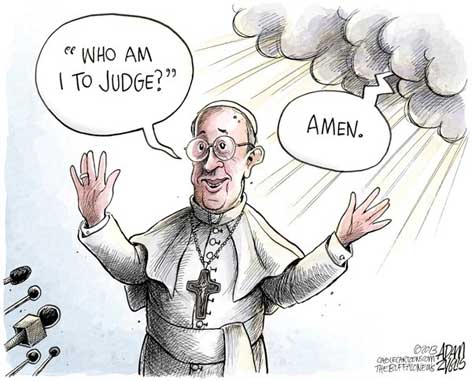
In addition to the changes mentioned, the church’s longstanding teaching on the primacy of conscience would be taken into account, where an informed conscience has been considered the final arbiter of man’s moral life. The teaching has stated that after individuals have been properly educated on the teaching of the church and understand the principles of the moral law, they can then apply those principles to their own unique circumstances (19). Though the decisions of the church hierarchy regarding the status of their union would be respected, more freedom could be given so that the consciences of couples would have the final say in discerning whether theirs was a valid union, a sacramental one, or none at all.
Some may object that a union couldn’t involve true love if there was a chance it may be temporary, yet in Jesus discussion with the Sadducees he declared that in the next life all marriages would cease to exist (20). The teaching of eternal romantic unions has not been a Christian one, yet sometimes Christians have idealised marriage almost as if it is has been. As was observed in the encyclical: “At times we have… proposed a far too abstract and almost artificial theological ideal of marriage, far removed from the concrete situations and practical possibilities of real families. This excessive idealisation… has not helped make marriage more desirable and attractive, but quite the opposite” (10). So what is the purpose of romance then? That through giving ourselves fully to our spouse, and if we conceive, our children, we learn the way of love.
Looking at the evidence, it’s clear the proposal presented is not a corruption of Christian doctrine, but rather a legitimate development of it. The words of Jesus against divorce can be viewed in a new light as applying to those who have entered into the fullness of marriage. Moses permitted divorce because he could see the hardness of some men’s hearts in his day weren’t ready to receive the fullness of it. Consider that Catholic teaching has stated that the Orthodox Church has had legitimate apostolic succession for a millennium since splitting from them in 1054 (19). This means they’ve been considered to have a legitimate teaching authority to guard the true teaching of the Church, in spite of the fact that they have been permitting divorce and remarriage quite liberally in comparison to what Catholics have ordinarily allowed. The Orthodox teaching on divorce and remarriage is not as clearly defined as it has been with Catholics. So, is the church simply to hold that all the unions the Orthodox Church dissolved were full annulments, or could it grant instead that the Orthodox had been implicitly acknowledging a marriage that occurs in stages as set forth here? Clearly the church has had some ambiguity in this area of its teaching long before the recent synods, and this proposal is a chance to clear that up. In the past, the two stage process was implicitly believed and practiced; now it’s being proposed that it should be explicitly believed and practiced.
Closing remarks
When the church is functioning at its best, it holds up the supposedly opposing ideas of justice and mercy perfectly alongside one another. This simply means proclaiming a high ideal on the one hand, whilst acknowledging human weakness on the other, which is what this proposal could bring to the Church in the area of marriage. Vatican II represents a time for the Church to enter into dialogue and reflection, a time to truly listen to those outside its ordinary boundaries. But that listening needs to end in concrete action. Marriage is in jeopardy in many parts of the world, and the Church urgently needs to renew it. Modern trends in romantic relationships have lead to a lack of any concrete commitments between couples with damaging effects, as the synod noted “We treat affective relationships the way we treat material objects and the environment; everyone uses and throws away, takes and breaks, exploits and squeezes to the last drop” (10).
The Church can’t go back to 19th century ideals of courtship that may have lacked an authentic freedom and a proper understanding of human weakness. It can only move forward. It needs to get rid of any remnants of a puritanical way of viewing sexuality and marriage so that the focus can shift to a more organic focus on sacrificial love, which is what authentic Christianity has always been about. Yet at the same time, there needs to be concrete doctrine and discipline in place to fully uphold the ideal of marriage.
As the French writer Victor Hugo once stated “nothing is more powerful than an idea whose time has come”. The time for has come for the reimagining of Christian marriage. It’s time to bring an end to the war that has broken out between the conservatives and liberals of the Church, and restore marriage to its true ideal.
References
(1) These four cardinals asked Pope Francis to clarify ‘Amoris laetitia’. (2016, November 14). Retrieved from Catholic news agency: https://www.catholicnewsagency.com/news/these-four-cardinals-asked-pope-francis-to-clarify-amoris-laetitia-43614
(2) Pentin, E. (2017, September 23). Clergy and Lay Scholars Issue Filial Correction of Pope Francis. Retrieved from National Catholic register: http://www.ncregister.com/blog/edward-pentin/group-of-clergy-and-laity-issue-filial-correction-of-pope-francis
(3) Mark 10:2-9, Matt 19:3-8
(4) Lk 16:18, Mt 5:31-32, Mk 10:11-12 (5) 1 Cor 7:15 (6) Ott, L. (1974). Fundamentals of Catholic Dogma. Charlotte, North carolina: TAN books., p 465-468 (7) Annulment of marriage. (n.d.). Retrieved from Syndey Catholic: https://www.sydneycatholic.org/marriage/annulment_of_marriage.asp
(8) Davies, N. (1997). Europe: A history. London: Pimplico.
(9) Dann, G. E. (1992). Leaving Fundamentalism. Waterloo, Ontario: Wilfrid Laurier University Press.
(10) I, P. F. (2016). Amoris Laetitia. Retrieved from https://w2.vatican.va/content/dam/francesco/pdf/apost_exhortations/documents/papa-francesco_esortazione-ap_20160319_amoris-laetitia_en.pdf
(11) Ott, L. (1974). Fundamentals of Catholic Dogma. Charlotte, North Carolina: TAN books., p 7-8
(12) Marriage: Secret and Clandestine Unions. (n.d.). Retrieved from Encyclopedia.com: http://www.encyclopedia.com/history/news-wires-white-papers-and-books/marriage-secret-and-clandestine-unions
(13) Gaynor, H.A. (1908). Concubinage. In The Catholic Encyclopaedia. New York: Robert Appleton Company. Retrieved March 17, 2018 from New Advent: http://www.newadvent.org/cathen/04207a.htm
(14) Von Ehesachen (Concerning Matrimonial Matters), A. D. 1530.What Luther Says, Ewald M. Plass, Concordia Publishing House, 1959, 3 volumes, (1994, 3 vols. in 1), ISBN 0570042402, p. 896.
(15) Risch, M. G. (n.d.). A betrothal Propoal. Retrieved from U.S. Catholic: http://www.uscatholic.org/life/2008/06/a-betrothal-proposal
(16) O’Neill, J.D. (1908). Clandestinity (in Canon Law). In The Catholic Encyclopaedia. New York: Robert Appleton Company. Retrieved March 17, 2018 from New Advent: http://www.newadvent.org/cathen/04001a.htm
(17) THE FINAL REPORT OF THE SYNOD OF BISHOPS. (2015, October 24). Retrieved from http://www.vatican.va/roman_curia/synod/documents/rc_synod_doc_20151026_relazione-finale-xiv-assemblea_en.html
(18) Western, J.-H. (2016, June 17). Most Catholic marriages are null, some ‘cohabitions’ are ‘real marriage’. Retrieved from LifeSite: https://www.lifesitenews.com/news/pope-francis-most-marriages-are-null-some-cohabitations-are-real-marriage
(19) Catechism of the Catholic Church (second edition ed.). (1992). St. Pauls publications.
(20) Matthew 22:30
(21) Paul VI (1968, July 25). Humanae Vitae. Retrieved from http://w2.vatican.va/content/paul-vi/en/encyclicals/documents/hf_p-vi_enc_25071968_humanae-vitae.html
(22) (2009). In Search of a Universal Ethic: A New Look at the Natural Law. Retrieved from http://www.vatican.va/roman_curia/congregations/cfaith/cti_documents/rc_con_cfaith_doc_20090520_legge-naturale_en.html
* In the past, the church stressed that a contraceptive mentality that was closed to life was something that prevented couples from fully loving one another, and that the procreative aspect of sexuality could never be ignored (21). Yet as was stated elsewhere by the Church, the smaller parts of man’s moral life have to be considered in the context of the whole (22). There can often be good reasons for a couple delaying having children.

 Middle Way Religion
Clarity needed on your proposal:
During the ‘initiation period’ and prior to the marriage ceremony, are you proposing that Church teaching say that it is ok for the couple to engage in the sexual act?
If yes, wouldn’t it lay the ground for a licence to ‘use and throw away’, ‘exploit and squeeze to the last drop’? The ‘initiation period’ could then be treated as ‘testing if this person is really right for me, including sexually’ but one could always become ‘tired’ / ‘bored’ and decide after a couple of ’rounds’ that this person is after all, not really a ‘fit’ and move on to the next couple of ’rounds’ with the next person…
‘Once the couple was fully ready to commit to marriage and had the economic resources to do so, then the marriage ceremony would take place, and their union would become consummated. It would then fully be a sacramental marriage, and hence indissoluble.’
Does this imply a change in the definition – contra Canon 1061 §1 – of consummation? In other words, are you proposing that consummation be considered as having come into effect simply by the marriage ceremony, irrespective of whether sexual act has taken place prior to or after the marriage ceremony?
Also, re dubia, FYI: see
1 of 3) case study at https://musingsfromaperiphery.blogspot.com/2017/10/the-sarah-case.html [is the ‘less rigorous’ approach to sacramental discipline as developed there doctrinally sound?]
2 of 3) https://musingsfromaperiphery.blogspot.com/2017/11/sarah-is-not-eligible-for-sacramental.html [is there an obex hindering absolution?]
and
3 of 3) a possible reply to the dubia at https://musingsfromaperiphery.blogspot.com/2017/10/a-response-to-dubia-of-four-cardinals.html
LikeLike
Hey,
In response to your first question, it is true that it could be abused, yes. The idea is that if there was an understanding that the initiation period was a general preparation for marriage, the chances of that happening would be greatly reduced.
In response to your second question, the betrothal proposal of Lawler and Risch (reference number 15) claimed that in the 12th century many had sexual relations prior to the wedding ceremony with consent being given in the future tense. Their proposal was based on that, which I think is imperfect. My proposal is that the non-defined doctrine that all valid unions between Christians are automatically sacramental be changed. So couples with the intention of fully loving the other and moving toward marriage would be in consummated valid unions, but not consummated sacramental unions. Their valid union would be a pathway to sacramental marriage. Thankyou for the comment though, I’ll adjust the wording slightly in that section so that it is a little more clear.
In regard to your links, when I get the time I’ll give them a read. In the meantime, if you have any friends who might find this article interesting, send them over here.
Reply
Like
LikeLike
‘The idea is that if there was an understanding that the initiation period was a general preparation for marriage, the chances of that happening would be greatly reduced.’
I’m afraid this still needs clarification. If the couple in ‘the initiation period’ choose to “test” each other including on the sexual level, with the door left open in some cases for a determination that there is, after all, no compatibility or interest left on that level, are you saying that the Church should say that that is fine?
How would the chances of abuse happening be greatly reduced simply by an understanding, when the very understanding presumably includes an ‘escape clause’ whereby a couple can decide after some rounds of ‘testing’ that perhaps they are not quite a fit for each other?
‘My proposal is that the non-defined doctrine that all valid unions between Christians are automatically sacramental be changed.’
Be changed to what precisely? Simply saying they are not ‘automatically sacramental’ wouldn’t suffice. There needs to be precision and clarity in the proposal on when exactly a sacramental union comes into existence.
‘couples with the intention of fully loving the other and moving toward marriage would be in consummated valid unions, but not consummated sacramental unions.’
Does that mean that couples who don’t have that intention are in consummated invalid unions? And what if the intention is present only on the part of one of the parties and not the other? Doesn’t current practice regarding annulments actually suffice to deal with such situations instead of the change which you propose?
LikeLike
-The idea of the proposal is that in accommodating for human weakness there is a more likely chance of restoring marriage to its true ideal than the current structure which holds up an ideal that’s too difficult for many to attain. In seeing the bar set too high, many avoid even trying to strive for the ideal. I quoted Amoris Laetitia in a number of places demonstrating that the church is currently leaning in the direction of this proposal. For instance, the idea that couple’s engagement periods are not long enough and they don’t have enough time to test their compatibility. Also the idea that unions with a firm commitment, open to life, could be seen as valid pathways to marriage.
-In ordinary circumstances the sacramental union would come into place when the couple celebrated their wedding with a priest, but under extraordinary circumstances it could take place outside of that if the couple was completely willing and did not have a priest present. Also, in cases where the couples weren’t educated on what a sacramental marriage entailed, they may not have been united together when it was celebrated by the priest. It would be the couple’s conscience which would be decider of the moment they entered a valid union, in the initiation stage, or a sacramental union later on. Making the commitment of either valid or sacramental union in a public setting (betrothal pledge for valid unions, marriage ceremony for sacramental unions) would simply help to establish it. Doctrine currently states (reference 6) that it’s the will of the couples rather than the priestly blessing which creates the marriage bond. The same would apply here. Church tribunals could discern whether they thought there was a valid union, sacramental union, or none present at all would have the right to take disciplinary action is some cases. But still the couples conscience would be the final decider
-Current annulments only allow for situations where couple’s weren’t considered mature enough to commit to marriage when they were wed. They don’t allow for situations where couples were perhaps mature enough for ‘natural marriage’, but not the fullness of marriage ‘sacramental marriage’. The claim of this proposal is that this two stage process has always been implicitly present throughout church history
LikeLike